24VAC thermostat add-on
Overview
This add-on turns your CTRL ONE into a fully-featured smart thermostat, capable of controlling simple 3-wire heating systems such as furnaces and in-floor heating. An isolated power supply runs the CTRL ONE safely from your heating system 24 V AC power, allowing it to be wall-mounted to standard 60 mm wall receptacles.
With the add-on installed, the CTRL ONE exposes a thermostat controller that can be managed from the touchscreen or directly from Home Assistant - with no cloud or separate app required. Use the full power of Home Assistant to create automations, relying on other sensors around the home: for example, turn the heating down when nobody is at home using the home/away capability.
The CTRL ONE is a fully standalone thermostat, and will continue functioning if the WiFi cuts out or Home Assistant goes down. With the onboard SCD40 temperature sensor you can set the temperature setpoint directly on the device.
Installation
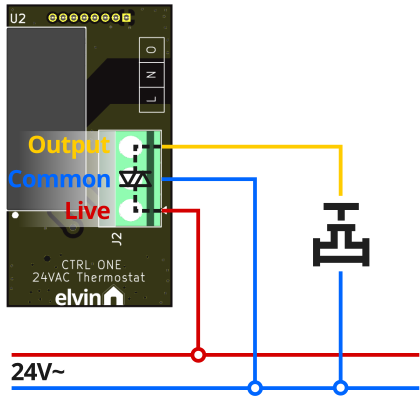
The add-on comes with 3 screw terminals, with each terminal marked on the board by a diagram next to the terminal.
L | Live |
N | Neutral/Common |
O | Output/Heat |
The Output is commonly known as Heat, and will be treated as such in the default configuration. However, it can be repurposed to actuate any other supported load by customising the ESPHome configuration.
Before connecting the add-on to the CTRL ONE, connect the load as shown in the diagram above, with it between the output and common wires. The CTRL ONE will bridge the Output to the Live wire when activated.
Note that the wire colors shown are purely indicative and vary based on the region and installation. Be sure to check your system thoroughly to identify which is which. Connecting in the wrong order may cause a short circuit, which may damage your heating system and/or CTRL ONE.
Once the wires are in the correct screw terminals, remove the backing paper from the adhesive strip on the add-on and install it into the add-on slot on the CTRL ONE. Make sure to push down firmly on both ends to ensure good contact. Now would be a good time to test the system, before attaching it to the wall.
ESPHome configuration
The CTRL ONE must be reconfigured to add the thermostat functionality before use. The add-on defines a switch on the add-on pin, wired to an ESPHome thermostat climate component that uses the onboard SCD40 as its temperature sensor. Import it into your ESPHome configuration with a packages: entry:
packages:
  thermostat:
    refresh: 4h
    url: https://codeberg.org/elvinhome/ctrl-one
    files:
      - path: esphome/addons/addon-24vac-thermostat.yaml
        vars:
          demand_energises_output: true
See the ESPHome configuration page for how packages work, or view the file directly in the Codeberg repository.
demand_energises_output allows the behaviour of the heating to be inverted. If set to false, the output will be energised when the thermostat is idle, and will be unpowered when heat is needed. This defaults to true.
Specifications
For the technical specifications of the add-on, check the product page.
Technical & safety notes
Do not use the USB port while the CTRL ONE is powered via this add-on. While every effort has been made to ensure safety, we are not responsible for damage caused to the CTRL ONE or connected devices if the USB port is used while powered via the 24VAC add-on.
This add-on protrudes out of the rear of the CTRL ONE and is intended for applications where the device is mounted to a 60 mm recessed wall mount. It will not work with the stand included with the CTRL ONE.
The add-on is Normally Open (NO). This means that when the switch is off, the output is not energised. If the add-on is installed without configuring the thermostat, or the CTRL ONE fails, the output will be off.
The output is connected to the live terminal when energised, through a TRIAC. This component has a minimum latching current (see product page) and therefore only works on systems that place a load on the output. It is not compatible with dry contact systems that are potential-free.
This add-on is NOT suitable for high voltage systems (110V, 230V). It supports low-voltage, 24 V~ AC systems only. Attempting to do so will destroy the add-on and is a shock risk due to exposed contacts on the board.
See the product page for ordering information.