
Hi, my name's Elvin, and I make smart things for your home. You've stumbled across a small website called elvinhome. I hope that the name is self-explanatory!
Let's start off with who I am first. You know my name, and I'm a Dutch national living in the Netherlands, but born in England. I started working at age 19, and whether it was luck or just knowing the right people, I managed to walk into an IT job interview that mostly consisted of asking whether I knew how to work with Windows, and how to make Excel macros. I said yes to both things.
Now I'm not going to say I was lying, but I definitely had a "dive in the deep end, and learn fast enough to stay afloat" approach. To be fair, Dutch interviews definitely come with a large "vibe check" aspect, so I assume I passed that. I was working for a small company of about 30 people, and anyone working IT at a company of that size knows that one day you'll be configuring a server, and the next setting up a portable AC unit because we're all working from an old building in the center of Amsterdam, with the thermal properties of a tin can. If it has a plug on the end of it, it's part of the job description.
The world moves fast and the company started getting smarter. The core business was collecting data on how people used office spaces to optimise its usage, and what started with real humans walking around with clipboards turned into a sensor in every meeting room, and under every desk. It was not without its hiccups; at the time wireless technologies such as Zigbee were in their infancy, and something like Matter was unheard of. And the last thing any IT department wanted to do was let us touch their precious corporate WiFi network with these little IoT things that their facilities team insisted we install. On one project we had so many issues with sensors dropping out that we installed 3 under every desk, only to find that they started dropping even faster due to Zigbee struggling under the load of all the additional devices in a small space.
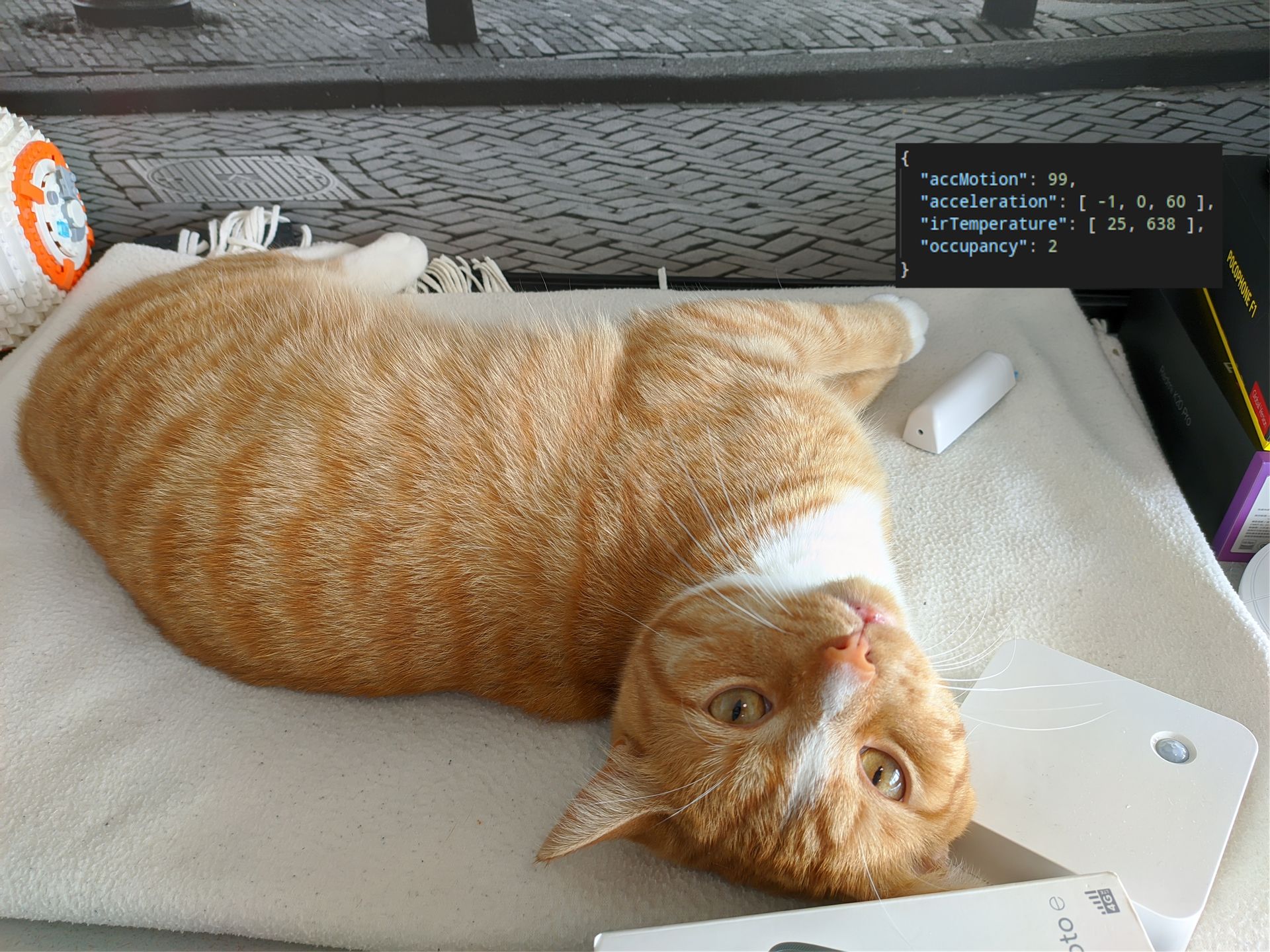
A picture of my old cat Edison, helping me test some prototype LoRaWAN occupancy sensors in the field. i.e. at home
Eventually, I proposed we turn to LoRaWAN, a budding new wireless technology at the time. You might have heard it today in the form of Meshtastic, an off-grid communication tool that forms a mesh network to forward messages among peers. They both use the LoRa radio, but LoRaWAN is designed for a more traditional deployment of base stations picking up messages from very low-power devices in the field. In open space these sensors could transmit for tens of kilometres, but for our use case it was able to punch through a few floors in a crowded office environment.
What both of these solutions had in common was the need for a backend to receive, store, and process the data. As these devices were deployed for short- to medium-term projects all over the world, the cloud was the obvious choice. AWS was the platform chosen, where we ingested data flowing in from 4G-connected base stations from anywhere. Data security and the new-fangled GDPR regulations were always top-of-mind, and the main lesson I learned from being the one in charge of the platform was this:
The ultimate data security is not having that data at all.
I explored countless different technologies and solutions. While many were limited by things like battery life and signal range, many, like camera-based solutions, had major data privacy concerns. While we could make as many promises as we wanted that the data would be captured from the images and then they would be deleted, those images still needed to flow into our cloud infrastructure first. At that company scale, I and many others had full admin privileges. And I know that if I had it, that every other company in the space must just be making the same promises.
That story had a happy ending - we managed to find an infrared sensor that could detect an 8x8 grid, essentially giving us 64 pixels that we could use to estimate the number of people in a meeting room. The sensor would just emit the number that it estimated, and it had no physical way of identifying who was there; something that could be easily done with traditional cameras. Because at the end of the day, the ultimate way to ensure privacy, is to not have this data at all.
This is the philosophy I want to continue with elvinhome. I don't want your data. And if I do build something that requires your data in the future, it needs to meet the following criteria:
- It should still perform its base function without the cloud,
- You should have the ability to self-host if you do want to use it,
- The device should only be physically capable of capturing the data it needs to perform its function.
I've worked as an AWS cloud consultant with a security background for over 5 years. I've seen for myself the steps missed, the corners cut and the data breaches play out in real time. elvinhome is me throwing my hat into the ring against a sea of cloud-connected devices transmitting your every action to who knows where, to make something that's in your control. I can't make promises that they'll always be as simple and convenient to set up as "download our app and make an account", but the space has come a long way in the last few years. I have the Open Home Foundation, and many others, to thank for that.
I'll be releasing my first product, the CTRL ONE, soon. Any feedback will be greatly appreciated, as there's no built-in telemetry that will be telling me what you like and don't like. It's a leap into the unknown, going from designing and deploying sensor solutions in the corporate world, to putting one in your home. I hope you'll like it!